Bed bug heat and contact remediation addresses severe infestations across established Cobb County communities, ranging from historic homes near Whitlock Heights and Historic Marietta Square to multi-story floorplans…
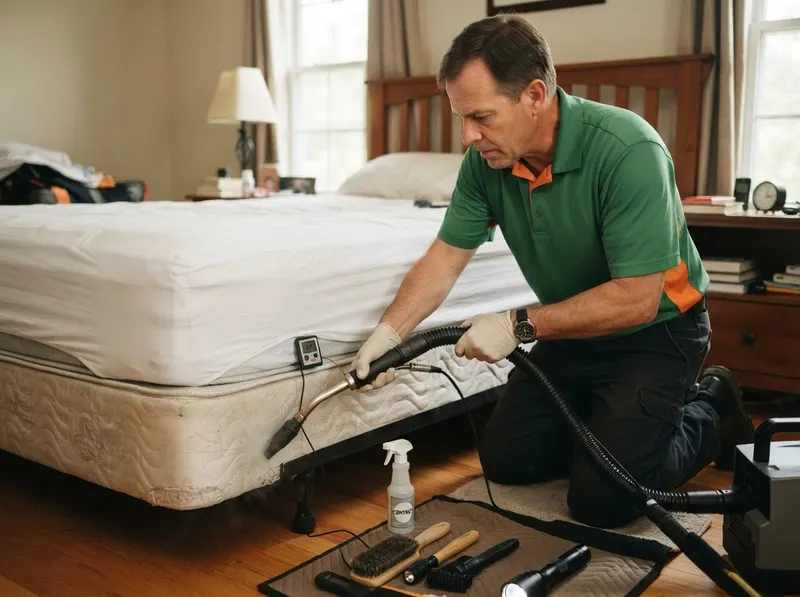
Bed bug heat and contact remediation addresses severe infestations across established Cobb County communities, ranging from historic homes near Whitlock Heights and Historic Marietta Square to multi-story floorplans throughout East Cobb and Indian Hills. Structural pest eradication requires two synchronized mechanisms to ensure survival rates drop to zero. Specialized convection heaters raise the ambient room temperature between 120°F and 135°F, penetrating deep into wall cavities, mattress seams, and hardwood flooring where conventional sprays cannot reach. To prevent bed bugs from migrating into cooler exterior wall voids or escaping behind electrical wall plates, technicians deploy targeted botanical contact applications and silica dusts along room perimeters. This ensures that any insect attempting to flee the thermal zone contacts a lethal, chemical-free barrier.
Selecting between standalone chemical treatment and integrated thermal remediation depends on home layout and urgency. Chemical treatments alone often require three to four sequential applications spaced two weeks apart to target newly hatched eggs, which can leave sleeping areas compromised for up to two months. In contrast, thermal convection destroys the protective protein shell of bed bug eggs in a single 8-hour session. Homeowners in neighborhoods like Somerset, Chimney Springs, and Atlanta Country Club benefit from the single-day cycle, which eliminates the need to discard expensive furniture or expose households to persistent synthetic pesticides. The trade-off involves preparatory steps: residents must temporarily remove heat-sensitive items, including vinyl window blinds, wax candles, prescription medications, and aerosol cans, prior to the arrival of service equipment.
1. Initial thermal and visual mapping: Technicians inspect bed frames, headboards, baseboards, and crawlspace transitions using thermal sensors to identify cold zones and infestation density.
2. Space isolation and containment: High-temperature containment barriers seal off the treatment area to retain ambient heat and protect surrounding living spaces.
3. Convection heat deployment: Industrial electric heaters and axial air movers gradually circulate air up to 135°F, maintaining the lethal temperature threshold for a continuous minimum of 180 minutes.
4. Targeted contact application: Technicians apply non-toxic silica desiccants into baseboard voids, outlet boxes, and structural seams to neutralize escaping pests.
5. Post-cooling structural validation: Infrared thermometers measure structural cooling, confirming that thermal penetration reached all target voids before residents return.
Every job gets a firm, written price after a free on-site visit.
Tell us about your bed bug heat and contact remediation job in Marietta and we'll send a clear, written quote, usually the same day.
 Timberline Pest Control