Stinging insect hive removal addresses territorial colonies nesting in soffits, eaves, crawlspace vents, and branch canopies across residential properties. European hornets and bald-faced hornets routinely construct…
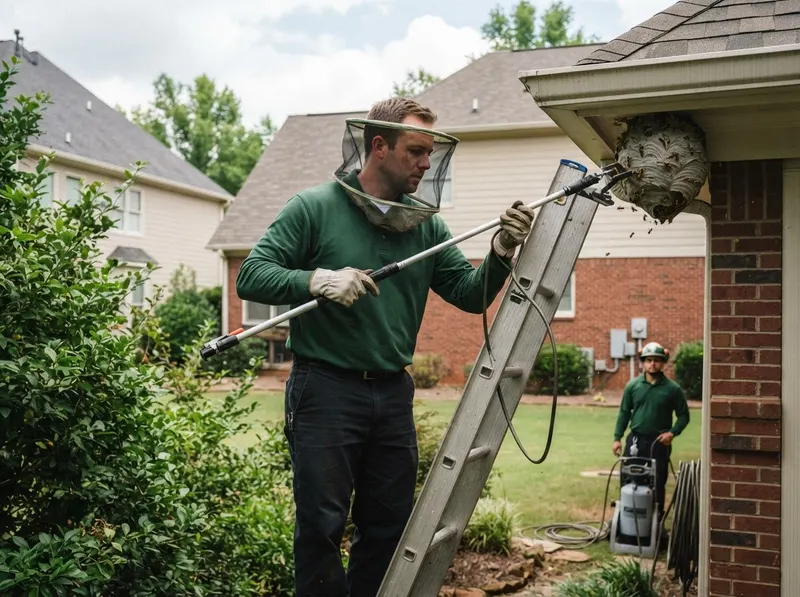
Stinging insect hive removal addresses territorial colonies nesting in soffits, eaves, crawlspace vents, and branch canopies across residential properties. European hornets and bald-faced hornets routinely construct paper-comb structures exceeding 14 inches in diameter beneath high roof peaks in East Cobb and Chimney Springs, while southern yellow jackets favor abandoned rodent burrows near decorative retaining walls in Indian Hills and Atlanta Country Club. Physical extraction differs fundamentally from exterior barrier sprays: perimeter repellent treatments do not penetrate the core brood chambers of established hives, leaving developing larvae to emerge days later. Professional removal neutralizes the defensive guard insects using focused thermal or botanical formulations, physically severs the structural attachment point from siding or masonry, and scrapes away the pheromone footprint to discourage future reconstruction.
Nesting locations dictate the mechanical approach and equipment required. Exposed exterior hives hanging from porch ceilings in Historic Marietta Square or garage gables in Whitlock Heights permit immediate physical detachment and disposal once workers are neutralized. Conversely, yellow jackets entering brick weep screeds or siding voids along residences in Somerset, Battleview, and West Park establish internal drywall nests. If insects chew through interior drywall into bedrooms or living rooms, a technician must open a clean inspection portal to extract the saturated combs rather than spraying chemicals from the outside, which risks forcing thousands of agitated stingers inward. The operational trade-off centers on non-destructive extraction versus structural void opening: exterior aerial removals avoid drywall repairs, whereas concealed cavity nests require opening and sealing the penetration point to prevent secondary carpet beetle infestations and rotting comb odors.
Preventative exclusion follows every physical hive extraction. After removing the active nest material from roof overhangs near Kennesaw Mountain National Battlefield Park or Forest Hills subdivisions, the underlying wood or masonry substrate receives a microencapsulated barrier application. Technicians seal adjacent soffit gaps measuring over 0.25 inches with silicone-based elastomeric caulking or stainless steel copper mesh to eliminate entry paths into warm attic insulation. Single-treatment services resolve isolated paper wasp umbrellas, whereas multi-queen aerial colonies require a follow-up assessment 48 hours later to capture foraging field workers returning to the original attachment site.
Every job gets a firm, written price after a free on-site visit.
Tell us about your stinging insect hive removal job in Marietta and we'll send a clear, written quote, usually the same day.
 Timberline Pest Control